


Page 63 - Industrial Plant 2020
P. 63
enable Ai  Group to propose safe and optimized
            solutions.


            Gas recompression systems

            and flare/vent network
            The LNG is stored in the tanks in its liquefied form at
            -162°C.
            In the tank, a small quantity of LNG evaporates
            continuously (“Boil Off Gas”).
            This evaporation is mainly caused by external heat
            input and/or fluctuations in liquid levels. Thus, this
            evaporation increases pressure inside the tank.
            The gas’ evaporation out of the tank is recovered
            through a compression and treatment system called
            “BOG system”.
            In the event of significant evaporation (or from BOG
            system’s failure), the tank’s pressure increases and
            emergency channels are provided to evacuate the
            overpressure according to the pressure threshold levels
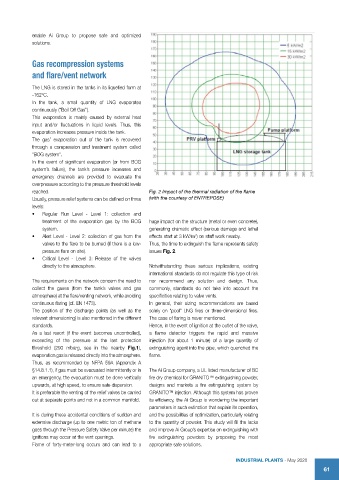
            reached.                                 Fig. 2 Impact of the thermal radiation of the flame
            Usually, pressure relief systems can be defined on three   (with the courtesy of ENTREPOSE)
            levels:
            •   Regular Run Level - Level 1: collection and
                treatment of the evaporation gas by the BOG   huge impact on the structure (metal or even concrete),
                system.                              generating dramatic effect (serious damage and lethal
            •   Alert Level - Level 2: collection of gas from the   effects start at 3 kW/m²) on staff work nearby.
                valves to the flare to be burned (if there is a low-  Thus, the time to extinguish the flame represents safety
                pressure flare on site).             issues Fig. 2.
            •   Critical  Level  -  Level  3:  Release  of the  valves
                directly to the atmosphere.          Notwithstanding these serious implications,  existing
                                                     international standards do not regulate this type of risk
            The requirements on the network concern the need to   nor recommend any solution and design. Thus,
            collect the gases (from the tank’s valves and gas   commonly, standards do not take into account the
            atmosphere) at the flare/venting network, while avoiding   specificities relating to valve vents.
            continuous flaring (cf. EN 1473).        In general, their sizing recommendations are based
            The position of the discharge points (as well as the   solely on “pool” LNG fires or three-dimensional fires.
            relevant dimensioning) is also mentioned in the different   The case of flaring is never mentioned.
            standards.                               Hence, in the event of ignition at the outlet of the valve,
            As a last resort (if the event becomes uncontrolled),   a flame detector triggers the rapid and massive
            exceeding  of  the  pressure  at  the  last  protection   injection (for about 1 minute) of a large quantity of
            threshold (290 mbarg, see in the nearby  Fig.1),   extinguishing agent into the pipe, which quenched the
            evaporation gas is released directly into the atmosphere.   flame.
            Thus, as recommended by NFPA 59A (Appendix A
            §14.8.1.1), if gas must be evacuated intermittently or in   The Ai Group company, a UL listed manufacturer of BC
            an emergency, the evacuation must be done vertically   fire dry chemical for GRANITO™ extinguishing powder,
            upwards, at high speed, to ensure safe dispersion.   designs and markets a fire extinguishing system by
            It is preferable the venting of the relief valves be carried   GRANITO™ injection. Although this system has proven
            out at separate points and not in a common manifold.  its efficiency, the Ai Group is wondering the important
                                                     parameters in such extinction that explain its operation,
            It is during these accidental conditions of sudden and   and the possibilities of optimization, particularly relating
            extensive discharge (up to one metric ton of methane   to the quantity of powder. This study will fill the lacks
            goes through the Pressure Safety Valve per minute) the   and improve Ai Group’s expertise on extinguishing with
            ignitions may occur at the vent openings.  fire extinguishing powders by proposing the most
            Flame of forty-meter-long occurs and can lead to a   appropriate safe solutions.

                                                                                    INDUSTRIAL PLANTS - May 2020
                                                                                                                   61

