


Page 16 - Industrial Plant 2020
P. 16
others as per burner manufacturers proprietary   content over the full rangeability of the burner. However,
                                 design;                               CO breakthrough can occur when operating outside of
                             •   Systems to prevent the NOx release into the   the burner capacity range: at overcapacity conditions
                                 atmosphere: de-NOx systems (SCR, NSCR) are   or below turndown, mainly due to loss of flame stability,
                                 available on the market for any kind of firing system.  incorrect mixing of fuel and air, inaccurate velocity, or
                                                                       improper staging.
                             The required NOx guarantee value depends mainly on
                             local laws and regulation or on the refinery emission   In order to reduce the CO content emissions, it is
                             thresholds. These can be estimated and provided by   suggested to adjust the operating conditions by
                             the burner and heater manufacturer on the basis of the   controlling the combustion air or properly setting up the
                             specific service, burner type, fuel and comburent   combustion variables.
                             properties.                               These kind of changes in operations can have an
                             The CO content in the flue gas depends only on   impact on the heaters’ performance but solve the
                             combustion quality with the correct mixing of fuel and   emissions challenge.
                             comburent.
                                                                       Process Study
                             CO emissions from a fired heater          Wood was requested by one major client to perform
                             During combustion  reaction, carbon and hydrogen   technical evaluation to improve the performance of
                             combine with oxygen to produce carbon dioxide and   many existing fired heaters. A thorough and diversified
                             water.  When combustion is complete, no carbon   study was carried out to address and propose various
                             monoxide is formed; if the combustion is incomplete,   solutions, both in terms of emissions and efficiency.
                             part of the carbon is not fully oxidized, producing   The analysis covered the refurbishment of many old
                             primarily carbon monoxide.                heaters to improve the efficiency, increase the capacity,
                                                                       change the service, reduce the coke formation and
                             The CO emission limit values are stated by API   reduce the emissions.
                             Standard 560 - Fired Heaters for General Refinery
                             Service:                                    Wood was requested by one major
                             “For floor-fired heaters, the CO content at the bridge   client to perform technical evaluation
                             wall shall be a maximum of 40 ml/m3 (40 ppm, by   to improve the performance of
                             volume) for gas-fired heaters, or 80 ml/m3 (80 ppm, by   many existing fired heaters
                             volume) for oil-fired heaters, at maximum design firing
                             conditions.”                              To reduce the CO emission of heater B-2, an upgrade
                                                                       of the combustion air control system was proposed.
                             The CO content in flue gases depends mainly on   In addition the thermal rerating of the existing heater
                             excess  air  sent  to  the  burners  and  on  the  correct   was performed with the aim to modify the heater
                             mixing of fuel and air to produce the required   configuration  considering  the current  operating
                             combustion reaction.                      conditions, to improve the combustion conditions and
                             The  carbon  monoxide  concentration  is  inversely   to reduce the CO content in the flue gases as much as
                             proportional to the excess air level and increase of CO   possible. CO emissions were too high with respect to
                             is linear but slow. At a certain point, called “CO   the strict local laws.
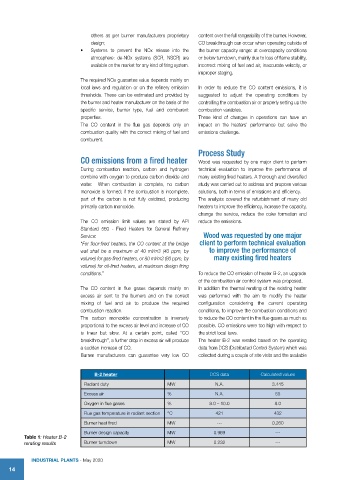
                             breakthrough”, a further drop in excess air will produce   The  heater  B-2  was rerated  based  on the operating
                             a sudden increase of CO.                  data from DCS (Distributed Control System) which was
                             Burner manufacturers can guarantee very low CO   collected during a couple of site visits and the available


                                  B-2 heater                               DCS data          Calculated values

                               Radiant duty                 MW               N.A.                3.445
                               Excess air                   %                N.A.                 55
                               Oxygen in flue gases         %              8.0 – 10.0            8.0
                               Flue gas temperature in radiant section  °C   421                 432
                               Burner heat fired            MW               ---                 0.260
                               Burner design capacity       MW              0.969                 ---
          Table 1: Heater B-2
          rerating results     Burner turndown              MW              0.232                 ---


            IndustrIal Plants - May 2020
    14

