


Page 45 - Industrial Plant 2020
P. 45
NO          NO2         NOx        NH3         HCL        HF       SO       Dust
                                                                                       2
               mg/Nm3      mg/Nm3      mg/Nm3      mg/Nm3     mg/Nm3     mg/Nm3    mg/Nm3   mg/Nm3   UM
                29,44        0,99       46,04       0,56        0,02       0,00     0,00     0,16    Average

                                        70,00       5,00        5,00       2,00     10,00    5,00    Limit

            Table 1: Emissions at stack (11% O2 dry)  measured during Performance Test.


            detailed analysis of the noise sources, mapping the   silencers and soundproofed booths, ensured that test
            sound  pressure  level at the perimeter  of the plant   values in the 40 measuring points identified during the
            (using 40 measuring points and found over 50 sound   design phase complied with the theoretical
            sources).                                 assumptions, following installation of the entire plant.
            During the first analysis, the engineers identified (on   The team also extended acoustic insulation to all
            project drawings) over 50 sound sources inside the   Redler transport systems, exhaust ducts from the De
            plant and 40 measuring points along the perimeter,   NOX extractor fan and other small sound sources to
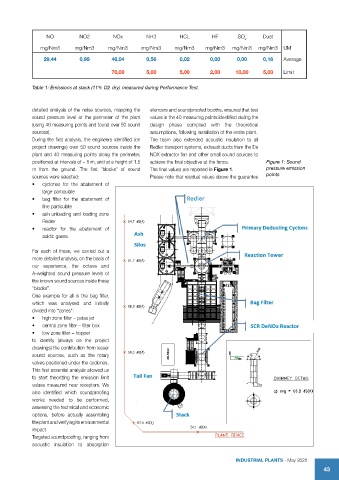
            positioned at intervals of ~ 5 m, and at a height of 1.5   achieve the final objective at the fence.  Figure 1: Sound
            m from the ground. The first “blocks” of sound   The final values are reported in Figure 1.  pressure emission
            sources were selected:                    Please note that residual values above the guarantee   points
            •   cyclones for the abatement of
                large particulate
            •   bag filter for the abatement of
                fine particulate
            •   ash unloading and loading zone
                Redler
            •   reactor for the abatement of
                acidic gases.

            For each of these, we carried out a
            more detailed analysis, on the basis of
            our experience, the octave and
            A-weighted sound pressure levels of
            the known sound sources inside these
            “blocks”.
            One example for all is the bag filter,
            which was analysed and initially
            divided into “zones”:
            •   high zone filter – pulse jet
            •   central zone filter – filter box
            •   low zone filter – hopper
            to identify (always on the project
            drawings) the contribution from lesser
            sound sources, such as the rotary
            valves positioned under the cyclones.
            This first essential analysis allowed us
            to start theorizing the emission limit
            values measured near receptors. We
            also identified which soundproofing
            works needed to be performed,
            assessing the technical and economic
            options, before actually assembling
            the plant and verifying its environmental
            impact.
            Targeted soundproofing, ranging from
            acoustic insulation to absorption

                                                                                    IndustrIal Plants - May 2020
                                                                                                                   43

