


Page 69 - Industrial Plant 2020
P. 69
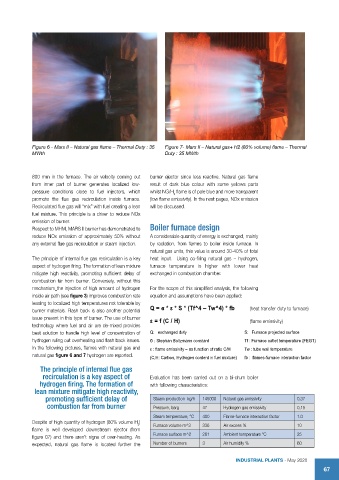
Figure 6 - Mars II – Natural gas flame – Thermal Duty : 35   Figure 7- Mars II – Natural gas+ H2 (80% volume) flame – Thermal
            MWth                                           Duty : 35 MWth


            800 mm in the furnace. The air velocity coming out   burner ejector since less reactive. Natural gas flame
            from inner part of burner generates localized low-  result of dark blue colour with some yellows parts
            pressure conditions close to fuel injectors, which   whilst NG/H  flame is of pale blue and more transparent
                                                              2
            promote the flue gas recirculation inside furnace.   (low flame emissivity). In the next pages, NOx emission
            Recirculated flue gas will “mix” with fuel creating a lean   will be discussed.
            fuel mixture. This principle is a driver to reduce NOx
            emission of burner.
            Respect to MHM, MARS II burner has demonstrated to  Boiler furnace design
            reduce NOx emission of approximately 50% without   A considerable quantity of energy is exchanged, mainly
            any external flue gas recirculation or steam injection.  by radiation, from flames to boiler inside furnace. In
                                                      natural gas units, this value is around 30-40% of total
            The principle of internal flue gas recirculation is a key   heat input.  Using co-firing natural gas – hydrogen,
            aspect of hydrogen firing. The formation of lean mixture   furnace temperature is higher with lower heat
            mitigate high reactivity, promoting sufficient delay of   exchanged in combustion chamber.
            combustion far from burner. Conversely, without this
            mechanism the injection of high amount of hydrogen   For the scope of this simplified analysis, the following
            inside air path (see figure 3) improves combustion rate   equation and assumptions have been applied:
            leading to localized high temperatures not tolerable by
            burner materials. Flash back is also another potential   Q = ϭ * ε * S * (Tf^4 – Tw^4) * fb   (heat transfer duty to furnace)
            issue present in this type of burner. The use of burner   ε = f (C / H)      (flame emissivity)
            technology where fuel and air are de-mixed provides
            best solution to handle high level of concentration of   Q:   exchanged duty   S:   Furnace projected surface
            hydrogen ruling out overheating and flash back issues.   Ϭ : Stephan Boltzmann constant  Tf : Furnace outlet temperature (FEGT)
            In the following pictures, flames with natural gas and   ε : flame emissivity – as function of ratio C/H  Tw : tube wall temperature
            natural gas figure 6 and 7 hydrogen are reported.  (C,H: Carbon, Hydrogen content in fuel mixture)  fb :  flames-furnace interaction factor

               The principle of internal flue gas
                recirculation is a key aspect of      Evaluation has been carried out on a bi-drum boiler
               hydrogen firing. The formation of      with following characteristics:
             lean mixture mitigate high reactivity,
                 promoting sufficient delay of         Steam production  kg/h  145000  Natural gas emissivity  0,37
                  combustion far from burner           Pressure, barg   47      Hydrogen gas emissivity  0,15

                                                       Steam temperature, °C  400   Flame-furnace interaction factor  1.0
            Despite of high quantity of hydrogen (80% volume H )
                                                 2     Furnace volume m^3  336   Air excess %            10
            flame is well developed downstream ejector (from
            figure 07) and there aren’t signs of over-heating. As   Furnace surface m^2  261  Ambient temperature °C  25
            expected, natural gas flame is located further the   Number of burners  3  Air humidity %    60

                                                                                    IndustrIal Plants - May 2020
                                                                                                                   67

