


Page 71 - Industrial Plant 2020
P. 71
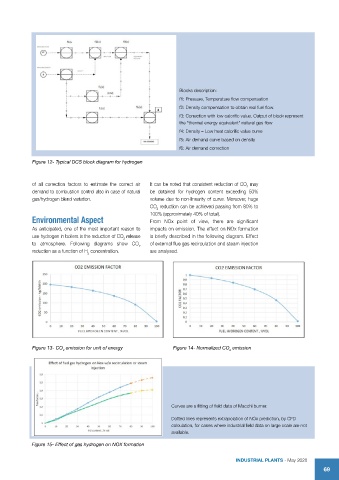
Blocks description:
                                                                f1: Pressure, Temperature flow compensation
                                                                f2: Density compensation to obtain real fuel flow.
                                                                f3: Correction with low calorific value. Output of block represent
                                                                the “thermal energy equivalent” natural gas flow
                                                                f4: Density – Low heat calorific value curve
                                                                f5: Air demand curve based on density
                                                                f6: Air demand correction

            Figure 12- Typical DCS block diagram for hydrogen


            of all correction factors to estimate the correct air   It can be noted that consistent reduction of CO  may
                                                                                        2
            demand to combustion control also in case of natural   be obtained for hydrogen content exceeding 50%
            gas/hydrogen blend variation.             volume due to non-linearity of curve. Moreover, huge
                                                      CO  reduction can be achieved passing from 80% to
                                                        2
                                                      100% (approximately 40% of total).
            Environmental Aspect                      From NOx point of view, there are significant
            As anticipated, one of the most important reason to   impacts on emission. The effect on NOx formation
            use hydrogen in boilers is the reduction of CO  release   is briefly described in the following diagram. Effect
                                            2
            to atmosphere.  Following diagrams show CO    of external flue gas recirculation and steam injection
                                                  2
            reduction as a function of H  concentration.  are analysed.
                                2


            Figure 13- CO  emission for unit of energy        Figure 14- Normalized CO  emission
                       2                                                          2


                                                             Curves are a fitting of field data of Macchi burner.

                                                             Dotted lines represents extrapolation of NOx prediction, by CFD
                                                             calculation, for cases where industrial field data on large scale are not
                                                             available.

            Figure 15- Effect of gas hydrogen on NOX formation

                                                                                    IndustrIal Plants - May 2020
                                                                                                                   69

