


Page 70 - Industrial Plant 2020
P. 70
Keeping same furnace size, furnace flue gas outlet temperature
                                                             increases considerably especially for H  content greater that 70%.
                                                                                       2
                                                             Higher flue gas temperature require careful evaluation of super-
                                                             heater thermal performance and re-evaluation of metallurgy of
                                                             tubes. The use of hydrogen, generally, requires more combustion
                                                             chamber surface to keep temperatures within typical industrial
                                                             limit (around 1400 °C-1450 °C). Nevertheless, in case of high
                                                             concentration, the furnaces size incresing may lead to expensive
                                                             design of boiler and external flue gas recirculation (EFGR) shall
                                                             be an unavoidable option. Principles and effects of EFGR will be
                                                             discussed in the next pages.


          Figure 8- Effect of Hydrogen on furnace outlet temperature


                              Combustion control                       Final scope is to maintain overall air/fuel ratio
                             If  hydrogen concentration in the fuel blend is   within burner limits avoiding sub-stoichiometric
                             constant, combustion control system does not   conditions.
                             require any particular precaution. Very often, its
                             content in fuel stream is variable and hence fuel   Following diagrams show fuel mixture parameter as
                             mixture properties at boiler entrance changes with   function of hydrogen concentration.
                             the time.  For this reason, combustion control logics
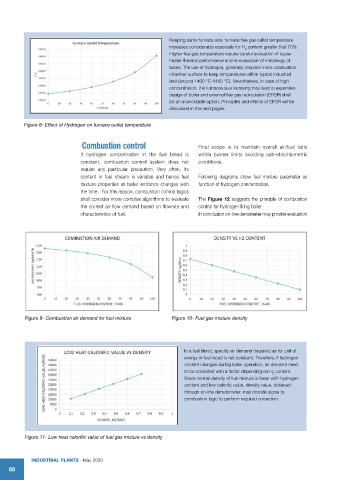
                             shall consider more complex algorithms to evaluate   The Figure 12 suggests the principle of combustion
                             the correct air-flow demand based on flowrate and   control for hydrogen firing boiler.
                             characteristics of fuel.                  In conclusion on-line densimeter may provide evaluation


          Figure 9- Combustion air demand for fuel mixture   Figure 10- Fuel gas mixture density


                                                                  In a fuel blend, specific air demand (required air for unit of
                                                                  energy of fuel input) is not constant. Therefore, if hydrogen
                                                                  content changes during boiler operation, air demand need
                                                                  to be corrected with a factor depending on H  content.
                                                                                                 2
                                                                  Since normal density of fuel mixture is linear with hydrogen
                                                                  content and low calorific value, density value, obtained
                                                                  through on-line densitometer, may provide signal to
                                                                  combustion logic to perform required correction.


          Figure 11- Low heat calorific value of fuel gas mixture vs density


            IndustrIal Plants - May 2020
    68

