


Page 72 - Industrial Plant 2020
P. 72
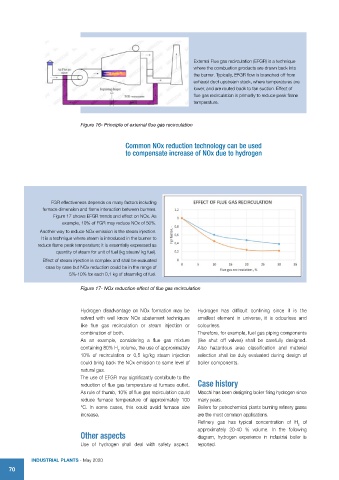
External Flue gas recirculation (EFGR) is a technique
                                                                     where the combustion products are drawn back into
                                                                     the burner. Typically, EFGR flow is branched off from
                                                                     exhaust duct upstream stack, where temperatures are
                                                                     lower, and are routed back to fan suction. Effect of
                                                                     flue gas recirculation is primarily to reduce peak flame
                                                                     temperature.


                             Figure 16- Principle of external flue gas recirculation


                                             Common NOx reduction technology can be used
                                             to compensate increase of NOx due to hydrogen


                   FGR effectiveness depends on many factors including
                furnace dimension and flame interaction between burners.
                    Figure 17 shows EFGR trends and effect on NOx. As
                       example, 10% of FGR may reduce NOx of 50%.
               Another way to reduce NOx emission is the steam injection.
                It is a technique where steam is introduced in the burner to
              reduce flame peak temperature; it is essentially expressed as
                     quantity of steam for unit of fuel (kg steam/ kg fuel).
                Effect of steam injection is complex and shall be evaluated
                 case by case but NOx reduction could be in the range of
                         5%-10% for each 0,1 kg of steam/kg of fuel.
                             Figure 17- NOx reduction effect of flue gas recirculation


                             Hydrogen disadvantage on NOx formation may be   Hydrogen has difficult confining since it is the
                             solved  with  well  know NOx abatement  techniques   smallest  element  in  universe,  it  is  odourless  and
                             like flue gas recirculation or steam injection or   colourless.
                             combination of both.                     Therefore, for example, fuel gas piping components
                             As an example, considering a flue gas mixture   (like shut off valves) shall be carefully designed.
                             containing 80% H  volume, the use of approximately   Also hazardous area classification and material
                                          2
                             10% of recirculation or 0,5 kg/kg steam injection   selection shall be duly evaluated during design of
                             could bring back the NOx emission to same level of   boiler components.
                             natural gas.
                             The use of EFGR may significantly contribute to the
                             reduction of flue gas temperature at furnace outlet.  Case history
                             As rule of thumb, 10% of flue gas recirculation could   Macchi has been designing boiler firing hydrogen since
                             reduce furnace temperature of approximately 100   many years.
                             °C. In some cases, this could avoid furnace size   Boilers for petrochemical plants burning refinery gases
                             increase.                                are the most common applications.
                                                                      Refinery gas has typical concentration of H  of
                                                                                                          2
                                                                      approximately 20-40 % volume. In the following
                             Other aspects                            diagram, hydrogen experience in industrial boiler is
                             Use of hydrogen shall deal with safety aspect.   reported.

            IndustrIal Plants - May 2020
    70

