


Page 90 - Industrial Plant 2020
P. 90
others and, in general, reduce the investment cost
                                                                       extensively without compromising the quality of  the
                                                                       equipment and materials used.
                                                                       This has led Euromel® Melamine plants to become
                                                                       particularly cost-effective.
                                                                       The trend for building ever-larger urea plants involves
                                                                       the demand for larger and more OPEX-efficient
                                                                       melamine plants as well.
                                                                       To cope with this trend, Eurotecnica has developed
                                                                       and implemented the 60,000 ton/year single-reactor
                                                                       single-train unit.
                                                                       As many as twenty-two Melamine plants worldwide are
                                                                       based on the Euromel® Melamine Process.


          QAFCO Melamine Plant – Mesaieed, Qatar - view of Euromel® Plant, the
          largest melamine plant in the Middle-East                    Technologies - Carbon Black
                                                                       Carbon black is a 12 million ton/year market, it’s
                                                                       expanding and covers a wide spectrum of growing
                             melamine have been produced to-date – a sign of its   applications.
                             superior quality.                         Carbon black is primarily used in the manufacturing of
                             Originally introduced in the 1960s, this high-pressure   rubber-based goods, such as tires, where it plays a
                             non-catalytic  technology  was  ahead  of  its  time  and   vital role in increasing tire’s tread wear and rolling
                             considered truly innovative because it was the first   resistance. Regardless how the new vehicles are
                             high-pressure melamine technology ever implemented   powered, either by engines or electric motors, they will
                             in a commercial-scale plant.              always need tires.
                             Across the years, the Euromel  melamine process has   Carbon black is a 12 million ton/year  market,  it’s
                                                  ®
                             enjoyed some remarkable improvements that make it a   expanding and covers a wide spectrum of growing
                             unique technology, thanks to a skilful R&D department   applications.
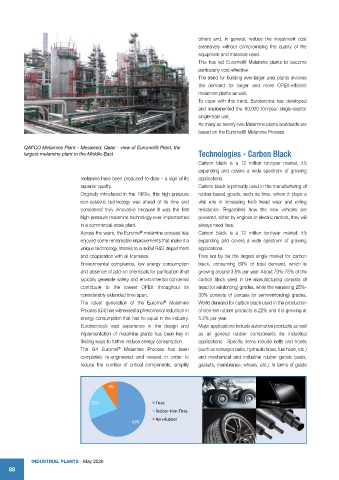
                             and cooperation with all licensees.       Tires are by far the largest single market for carbon
                             Environmental compliance, low energy consumption   black, consuming 69% of total demand, which is
                             and absence of add-on chemicals for purification (that   growing around 3.8% per year. About 70%-75% of the
                             typically generate safety and environmental concerns)   carbon black used in tire manufacturing consists of
                             contribute to the lowest OPEX throughout its   tread (or reinforcing) grades, while the remaining 25%-
                             considerably extended time span.          30% consists of carcass (or semireinforcing) grades.
                             The latest generation of the Euromel  Melamine   World demand for carbon black used in the production
                                                           ®
                             Process (G4) has witnessed a phenomenal reduction in   of non-tire rubber products is 22% and it is growing at
                             energy consumption that has no equal in the industry.   5.2% per year.
                             Eurotecnica’s vast experience in the design and   Major applications include automotive products as well
                             implementation of melamine plants has been key in   as all general rubber components for industrial
                             finding ways to further reduce energy consumption.  applications.  Specific items include belts and hoses
                                           ®
                             The G4 Euromel  Melamine Process has been   (such as conveyor belts, hydraulic hose, fuel hose, etc.)
                             completely re-engineered and revised in order to   and mechanical and industrial rubber goods (seals,
                             reduce the number of critical components, simplify   gaskets, membranes, wheels, etc.). In terms of grade


                                       9%


                                 22%                    Tires
                                                        Rubber-Non-Tires
                                                        Non-Rubber
                                               69%


            INDUSTRIAL PLANTS - May 2020
    88

