


Page 91 - Industrial Plant 2020
P. 91
mix,  the  rubber  non-tire  segment  uses 75%  of soft
            grades and only 25% consisting of hard grades.
            Global demand for special blacks, which encompasses
            all carbon black used in non-rubber applications, totals
            about 9% of the carbon black industry’s volumes but
            20% of its value, because of much higher prices. The
            largest single market for carbon black outside the
            rubber industry is in plastics compounding, which
            accounts for 52% of volume demand of special blacks.
            Printing inks, paints and coatings together account for
            another 20% of specialty blacks demand.
            Carbon black feedstock oils, such as FCC Slurry Oil,
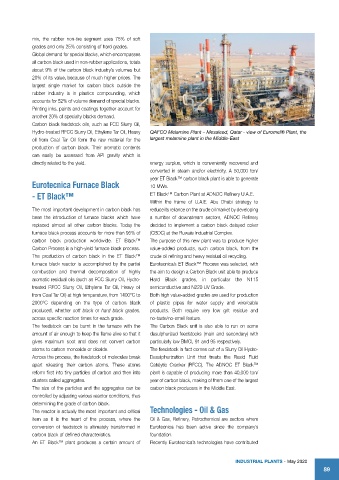
            Hydro-treated RFCC Slurry Oil, Ethylene Tar Oil, Heavy   QAFCO Melamine Plant – Mesaieed, Qatar - view of Euromel® Plant, the
            oil from Coal Tar Oil form the raw material for the   largest melamine plant in the Middle-East
            production of  carbon  black. Their  aromatic  contents
            can easily be assessed from API gravity which is
            directly related to the yield.            energy surplus, which is conveniently recovered and
                                                      converted in steam and/or electricity. A 50,000 ton/
                                                      year ET Black™ carbon black plant is able to generate
            Eurotecnica Furnace Black                 10 MWe.

            - ET Black™                               ET Black™ Carbon Plant at ADNOC Refinery U.A.E.
                                                      Within the  frame  of U.A.E.  Abu  Dhabi  strategy  to
            The most important development in carbon black has   reduce its reliance on the crude oil market by developing
            been  the  introduction  of furnace  blacks  which  have   a number of downstream sectors, ADNOC Refinery
            replaced  almost all  other  carbon  blacks. Today the   decided to implement a carbon black delayed coker
            furnace black process accounts for more than 95% of   (CBDC) at the Ruwais Industrial Complex.
            carbon black production worldwide. ET Black™   The purpose of this new plant was to produce higher
            Carbon Process is a high-yield furnace black process.  value-added products, such carbon black, from the
            The production of carbon black in the ET Black™   crude oil refining and heavy residual oil recycling.
            furnace black reactor is accomplished by the partial   Eurotecnica’s ET Black™ Process was selected, with
            combustion and thermal decomposition of highly   the aim to design a Carbon Black unit able to produce
            aromatic residual oils (such as FCC Slurry Oil, Hydro-  Hard Black grades, in particular the N115
            treated RFCC Slurry Oil, Ethylene Tar Oil, Heavy oil   semiconductive and N220 UV Grade.
            from Coal Tar Oil) at high temperature, from 1400°C to   Both high value-added grades are used for production
            2000°C depending on the type of carbon black   of plastic pipes for water supply and wire/cable
            produced, whether  soft black or  hard black grades.   products. Both require very low grit residue and
            across specific reaction times for each grade.   no-taste/no-smell feature.
            The feedstock can be burnt in the furnace with the   The Carbon Black unit is also able to run on some
            amount of air enough to keep the flame alive so that it   desulphurized feedstocks (main and secondary) with
            gives maximum soot and does not convert carbon   particularly low BMCI, 91 and 95 respectively.
            atoms to carbon monoxide or dioxide.      The feedstock in fact comes out of a Slurry Oil Hydro-
            Across the process, the feedstock oil molecules break   Desulphurization Unit that treats the Resid Fluid
            apart releasing their carbon atoms. These atoms   Catalytic  Cracker  (RFCC).  The ADNOC ET  Black™
            reform first into tiny particles of carbon and then into   plant is capable of producing more than 40,000 ton/
            clusters called aggregates.               year of carbon black, making of them one of the largest
            The size of the particles and the aggregates can be   carbon black producers in the Middle East.
            controlled by adjusting various reactor conditions, thus
            determining the grade of carbon black.
            The reactor is actually the most important and critical  Technologies - Oil & Gas
            item as it is the heart of the process, where the   Oil & Gas, Refinery, Petrochemical are sectors where
            conversion oil feedstock is ultimately transformed in   Eurotecnica has been active since the company’s
            carbon black of defined characteristics.  foundation.
            An ET Black™ plant produces a certain amount of   Recently Eurotecnica’s technologies have contributed


                                                                                    IndustrIal Plants - May 2020
                                                                                                                   89

